
Checking Criminal History in Nashville
Start with the record holder, not a broad name search. Nashville Police creates reports for incidents it investigates inside the city. The Washington County Sheriff creates the jail intake file when a person is booked. Andrea L. Renken's Circuit Clerk preserves the prosecution file after the State's Attorney files a charge. The Washington County Judici search is the online route for the public court index, while the Illinois State Police Bureau of Identification handles state criminal-history products.
A sound Nashville records check follows the event from its source to its outcome:
- Ask Nashville Police for the incident or arrest report created by its officers.
- Contact the Sheriff or jail for booking, custody, bond, hold, or release information.
- Search Washington County in Judici by legal name or a known case number.
- Order copies or certification from the Circuit Clerk when an online docket is not enough.
- Use ISP Access and Review with fingerprints to inspect and challenge your own Illinois history.
These channels answer different questions. A missing Judici result does not erase a police report, and a booking entry does not show the final court outcome.
Three Nashville Records Buildings
Nashville's county-seat role puts three major record offices within its civic core, yet each counter has a different job. The historic county building at 101 E. St. Louis Street houses county administration and the County Clerk and Recorder. That clerk handles vital, land, election, and county records, not criminal case files. The Washington County Judicial Center at 125 E. Elm Street houses the Circuit Court and Circuit Clerk. The Sheriff and county jail operate at 245 N. Kaskaskia Street.
This compact layout can make the system look more unified than it is. A person may receive three correct but different answers within a few blocks. Ask the county FOIA route about county administrative material, the Circuit Clerk about filed cases, and the Sheriff about sheriff reports or custody. Nashville police reports remain a fourth city-level category.
City Police
465 E. Walnut Street
Nashville, IL 62263
(618) 327-8274
Circuit Clerk
125 E. Elm Street
Nashville, IL 62263
(618) 327-4800 ext. 305
Sheriff and Jail
245 N. Kaskaskia Street
Nashville, IL 62263
(618) 327-8274
Nashville Police Department Records
The City of Nashville places the Police Department at 465 E. Walnut Street. The official county municipal profile names Chief Brian Fletcher, and the current county dispatch material identifies Nashville Police as an active local agency. Ask city police for an incident report made by a Nashville officer. The Washington County State's Attorney expressly tells report seekers to contact the arresting or investigating agency, not the prosecutor.
No verified Nashville police-record request form, arrest blotter, dedicated records portal, fee schedule, or mobile app was found in the official sources reviewed. The safe route is to contact police or City Hall, then submit a narrow Illinois FOIA request if needed. Give the date, approximate time, location, incident number if known, the exact record sought, preferred delivery format, and contact details. Those details help locate a record, but they are best practices rather than fields copied from a Nashville form.
City Hall is at 190 N. East Court Street and publishes (618) 327-3058. Confirm any current request instructions and cost before sending payment.
Nashville Report or Sheriff Booking
A Nashville police report and a Sheriff booking record document different parts of the same event. The city report can contain the call, alleged conduct, location, officer observations, witness information, evidence references, and arrest action, subject to redaction. The jail record begins when custody staff process the person. It emphasizes admission time, intake charge, arresting agency, bond or holds, release status, and local identifiers.
| Record | Holder | Best Use |
|---|---|---|
| Incident or arrest report | Nashville Police | Understand the reported event and police response |
| Booking record | Washington County Sheriff | Confirm county custody processing and release status |
| Criminal case file | Washington County Circuit Clerk | Read filed charges, orders, disposition, and sentence |
| Illinois history | ISP Bureau of Identification | Review fingerprint-linked cycles reported statewide |
Request both local records when the distinction matters. Neither one substitutes for the court file, and none should be read as proof of guilt without the disposition.
Nashville Arrests and Bookings
Nashville does not operate a separate city jail identified in the research. A person arrested by Nashville Police may be taken to the Washington County Jail at the Sheriff's Kaskaskia Street facility. Call the jail at (618) 327-4800 extension 114 for custody information. The official sources did not reveal a public county booking log or a Nashville arrest gallery, so a direct jail inquiry is the practical recent-custody route.
The booking charge is an intake fact. Prosecutors may later file a different charge, decline a charge, or proceed after further review. Search the Washington County arrest channels for fuller county-level routing, then use Judici to see whether a court case appeared. Older, sealed, delayed, or misspelled records may not show in an online name search.
Note: A Nashville arrest records an allegation and custody event; only the court file can show whether the case ended in conviction, dismissal, or acquittal.
Judici After a Nashville Arrest
Judici becomes useful after a Nashville matter is filed in the Washington County Circuit Court. Confirm that Washington County is selected, then search by name or case number. Legal surname is the sound starting point. A first name and accurate middle initial can narrow a common match, but a wrong initial may hide the right result. Case numbers often include a year, a two-letter case-type code, and a sequence.
The result may display a case header, parties, charge counts, docket events, hearings, dispositions, sentences, and financial information. Service labels such as Pay Now or Plea/Pay do not mean every case is eligible. Washington County limits Plea/Pay to eligible open TR traffic and CV conservation cases that do not require an appearance. The Circuit Clerk should confirm any ambiguous name match and supply documents not available online.
Online silence has several meanings. The matter may be too new, not filed, archived, sealed, expunged, or indexed under another spelling. It does not prove that no Nashville police contact occurred.
Municipal Court Records in Nashville
Nashville has no separate municipal court of record identified in the official sources. City status does not create a Nashville criminal clerk or city case portal. Ordinance, traffic, misdemeanor, and felony filings route through the Circuit Court of Illinois as law and court assignment require. For a city arrest that becomes a prosecution, the public lookup is Washington County Judici and the document counter is the Circuit Clerk at the Judicial Center.
| Court Name | Washington County Circuit Court, 24th Judicial Circuit |
|---|---|
| Case Types Heard | Felony, misdemeanor, traffic, conservation, ordinance, and related matters allocated by law or order |
| Case Lookup Channel | Washington County Judici search, then Circuit Clerk phone, email, or counter |
| What the Docket Shows | Case number, status, parties, charges, events, orders, disposition, sentence, and eligible financial entries |
| Copies & Fees | Published schedule lists $5 per name search, $1 per reproduced page, and certified copies at $3 plus 50 cents per page; confirm the applicable charge |
Do not send a police narrative request to the clerk. Court records begin with filed pleadings and orders, while the original report stays with Nashville Police.
Nashville's County-Seat Record History
Nashville was surveyed on June 8, 1830, and selected as the county seat in 1831. Commissioners first styled it New Nashville, reflecting Tennessee ties. The courthouse built in 1840 burned in 1883. Its replacement was completed in 1884 for $23,999, and a 1965 addition matched the brick, Indiana limestone, and mansard styling. That civic history helps explain why county administrative work remains on St. Louis Street while present-day criminal court business centers on Elm Street.
The 2024 Census estimate counted 3,006 Nashville residents citywide, including 2,954 in Washington County. Earlier figures were 3,097 in 2020 and 3,258 in the county's 2010 table. Population change does not measure crime or record volume. It does show why the county seat remains the main in-person records hub for both Nashville residents and people from smaller communities.
Historical buildings and modern record custody should not be confused. The older county building is important to Nashville's story, but the Judicial Center is the criminal-case destination.
Nashville Records Beyond Illinois
The U.S. District Court for the Southern District of Illinois is the federal court district covering Washington County.
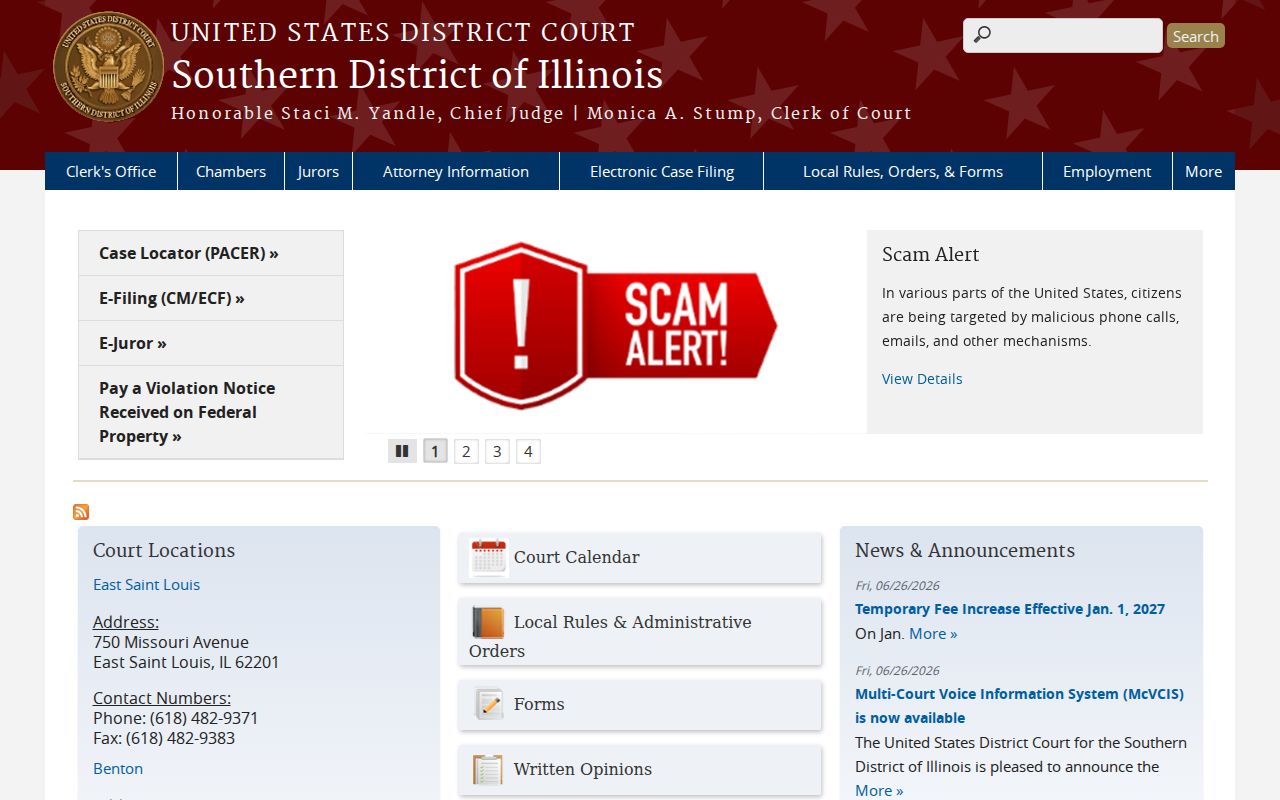
The district site identifies the federal system that is separate from Nashville police, county booking, and Illinois Circuit Court records.
The district's Benton courthouse page provides the relevant courthouse location information.
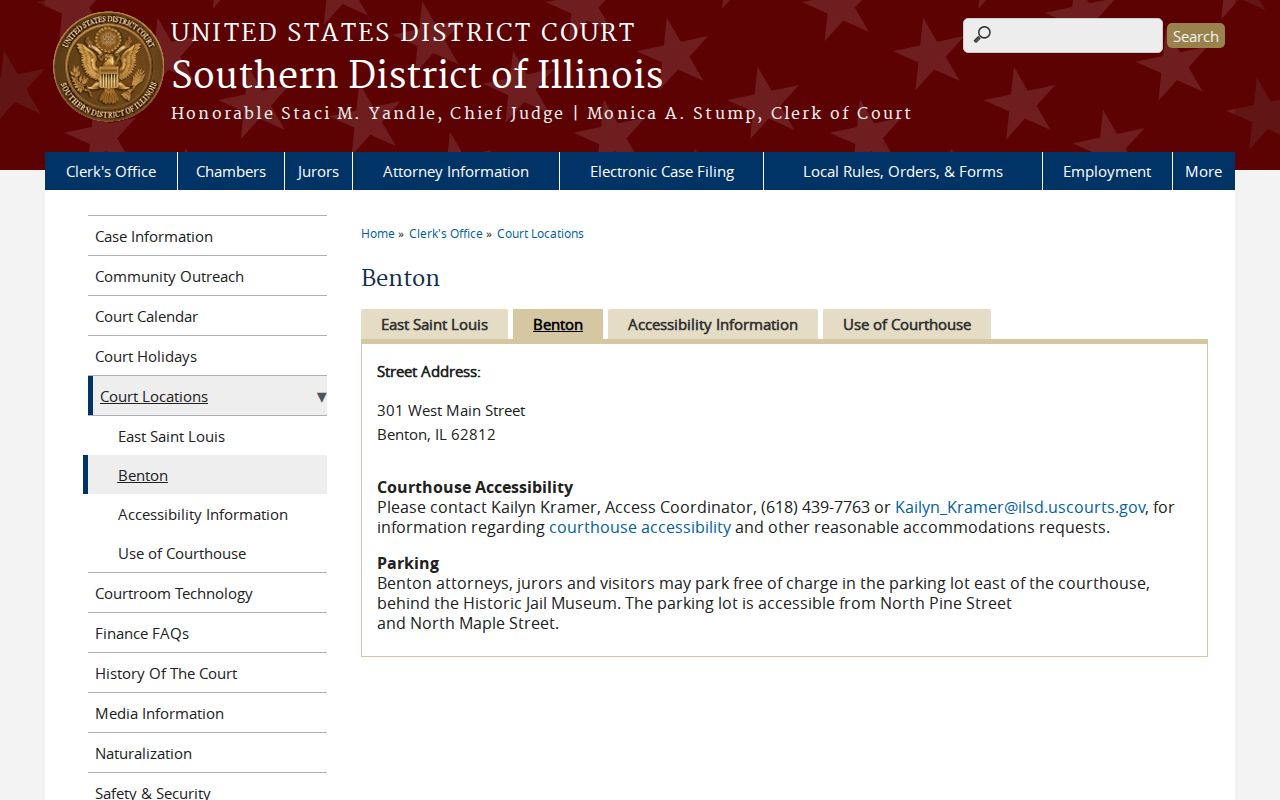
A federal docket belongs in PACER, not Washington County Judici, so the Benton information helps route the uncommon Nashville matter filed under federal law.
Where Nashville Records Go
A Nashville officer's report stays with Nashville Police. If the arrest leads to county custody, the Sheriff creates a separate booking file and transmits fingerprint-linked arrest data through Illinois reporting channels. The State's Attorney reviews the investigation and decides whether to prosecute. Once a case is filed, the Circuit Clerk opens the official court file. Its disposition should later flow to the Illinois State Police Bureau of Identification.
Record flow: Nashville Police Department › Washington County Sheriff booking › Washington County Circuit Court › Illinois State Police Bureau of Identification
Timing and identifiers matter. A new arrest can exist at the police department and jail before a court case appears online. A missing or mismatched disposition can also leave an arrest cycle incomplete in the state history. ISP Access and Review is the subject-facing route to inspect and challenge that statewide record. For the broader system, the Washington County criminal history overview separates local reports, court dockets, and state responses.
Reading Nashville Crime Records Carefully
The latest exact Nashville agency table extracted for the research was historical. ISP's 2013 Crime in Illinois report used a population of 3,204 and listed 58 index crimes: no homicide, one rape, five robberies, two aggravated assault or battery offenses, six burglaries, 43 thefts, one motor-vehicle theft, and no arson. Its displayed rate was 1,810.2 per 100,000.
Those figures describe one reporting year and one agency's participation. They are not a current crime estimate. Later ISP tables sometimes place Nashville under “no reportable incidents,” which is reporting-status language and must not be rewritten as zero crime. For current context, check the ISP Crime in Illinois annual reports or FBI Crime Data Explorer and note the year, coverage, and reporting status.
Small-city rates can swing sharply when a few events change. Raw totals, offense definitions, and agency participation should travel with any Nashville statistic.
Public Access Rules in Nashville
Nashville Police is subject to the Illinois Freedom of Information Act for qualifying agency records, but FOIA does not require staff to create a new analysis or answer questions. Exemptions can protect active-investigation details, confidential sources, juveniles, crime victims, personal data, and security methods. The agency should separate releasable portions when practical and explain a redaction or denial. Court files follow judicial access rules and court orders, so requests for pleadings and certified dispositions belong with the Circuit Clerk.
Key Statutes:
Illinois FOIA, 5 ILCS 140 sets the ordinary five-business-day response period, permits a stated extension, controls fees, and recognizes exemptions.
Uniform Conviction Information Act, 20 ILCS 2635 governs public Illinois conviction information held by the state.
Criminal Identification Act, 20 ILCS 2630 covers state history reporting, personal review, correction, expungement, and sealing.
A noncommercial FOIA response is generally due within five business days, subject to a permitted five-business-day extension with a written reason. A response may grant, redact, deny, seek clarification, or extend the request. It does not always mean immediate delivery.
Nashville Court Counter Planning
The Judicial Center is open weekdays from 8:00 a.m. to 4:00 p.m. The official directory lists an e-filing kiosk, printer, digital law library, self-help resources, disability coordination, remote-proceeding information, digital audio recording, and free parking. Call (618) 327-4800 extension 305 before a trip when a certified copy, archive search, or accommodation is needed.
County juror instructions say visitors report through the doors to security at the front desk and that cell phones are not permitted in the courthouse. The dress details published for jurors should not be extended to every records-counter visitor, but the phone restriction and security screening are practical concerns. Bring the case number on paper when possible. A legal name, date range, and known case type can help the clerk identify a Nashville matter.
Note: Confirm current building rules before travel, since a records search can fail when key names or case numbers are stored only on a prohibited phone.